A Closed Loop Will Maximise Whatever Number You Feed It
The post that came with this card is right about the thing most people get wrong. One agent writes scripts. Another makes thumbnails. They never talk to each other, so nothing compounds — you have automated two steps and called it a system.
What turns this diagram into a system is the fifth layer. The analytics agent reads what actually happened — click-through, retention, views in the first forty-eight hours — and hands it back to the strategist, who writes next month’s calendar from it. The loop closes. The calendar rewrites itself.
That is a genuinely good architecture, and it is also the point at which this stops being a tooling question and becomes a strategy one. A closed loop does not get better in general. It gets better at the number you put into it. Feed it three numbers and within a few months you will have a channel shaped by those three numbers, whether or not that is the channel you wanted.
So the seven agents are the easy part. The decision that actually matters is the one the diagram does not label: which measurement travels round the loop.
Five layers, and what moves between them
| 1 · PLANNING | 2 · WRITING | 3 · PACKAGING | 4 · BUILD | 5 · LOOP |
|---|---|---|---|---|
| Strategist | Scriptwriter | Thumbnail + SEO | Production | Publisher + Analytics |
| Trends and your last 30 days | One topic from the calendar | A finished script | A script, a voice and images | A published video |
| A dated calendar | A full script with hook and close | Three thumbnails, a title, tags | A cut ready to upload | Numbers — and they go back to layer one |
| Without it you make whatever you felt like | Without it the idea never becomes a video | Without it a good video is never clicked | Without it nothing ships | Without it nothing compounds |
The seven agents, as the card lists them
Every word in the first three columns is the card’s own.
| # | Agent | What the card says it does | Its steps |
|---|---|---|---|
| 01 | Strategist agent | Reads what is climbing right now, then plans your whole calendar | Pull trending topics in your niche · score each on demand vs competition · slot the winners into a dated calendar |
| 02 | Scriptwriter agent | Turns one topic into a full script: hook, story spine, real close | Hook inside the first 8 seconds · build the middle as story, not bullets · write the CTA in, do not bolt it on |
| 03 | Thumbnail agent | Builds A/B thumbnails | Generate 3 thumbnail variants each · A/B them to lift click-through rate |
| 04 | SEO agent | Writes titles, tags, keywords | Mine the keywords before the title · five title options, chapters, end screens |
| 05 | Production agent | Assembles the finished video: voice, images, and the final cut | Send the script to text to speech · generate image assets from the beats · export a cut that is ready to upload |
| 06 | Publisher agent | Uploads on schedule | Upload, schedule, set every option |
| 07 | Analytics agent | Feeds the results back to agent one | Track views, CTR and retention · the calendar rewrites itself monthly |
WATCH THE ORIGINAL — 45 SECONDS
All five layers with their file names, the pipeline, and the analytics panel feeding back into layer one.
▶ How to automate your entire YouTube channel — seven agents, five layers — BANI Academy on Facebook
The metric you choose becomes the channel you get
The analytics panel on the card shows three numbers going back to the strategist: click-through at 7.2%, retention at 54%, views in forty-eight hours at 12.4K. All three are real, useful measurements. All three are also instructions, because anything that gets optimised hard enough stops describing the thing and starts replacing it.
Think about what each one teaches a system that runs without supervision for six months.
Click-through rewards the gap between what the thumbnail promises and what a person expects inside. The fastest way to raise it is to widen that gap. Nobody writes that instruction; the loop discovers it, because it is true.
Retention rewards keeping people watching, which sounds unimpeachable until you notice the cheapest way to do it is to delay the answer. A system optimising retention will learn to withhold, to tease, to put the thing you came for at eight minutes.
Views in the first forty-eight hours rewards whatever is hot this week. The strategist already pulls trending topics; feed it a 48-hour metric and it will walk your channel out of your niche one calendar at a time, because this week’s trend always outperforms your subject.
None of that makes the architecture wrong. It makes the metric a decision, and a decision nobody can make for you — which is why the only sensible thing to put in that loop is a measure that matches what you are actually building.
| Feed the loop this | It learns to | The channel you end up with | The guard |
|---|---|---|---|
| Click-through | Promise more in the thumbnail than the video pays | High clicks, falling watch time, comments calling it bait | Pair it with retention — never optimise it alone |
| Retention | Delay the answer, pad the middle | Long videos that feel like a queue | Measure retention at 30 seconds, not average view duration |
| Views in 48 hours | Chase this week’s trend | A channel with no subject | Cap it: trends may fill one slot a month, not the calendar |
| Subscribers per video | Ask for the subscription harder | More CTAs, less substance | Use returning viewers instead |
| Returning viewers | Make the thing the same people come back for | Slow growth, a real audience | This is the one worth closing the loop on |
| Revenue per thousand views | Follow the advertisers, not the audience | Topics chosen by payout | Fine as a report. Dangerous as a loop input |
“A human still signs off” — but where?
That sentence sits in the smallest type on the whole card, bottom right, and it is carrying the entire thing. A loop with a human somewhere in it is a tool. The same loop with the human removed is a publishing machine with your name on it.
The useful version of that line names the gates. There are three, and they are not the same gate.
Gate one: the metric, before anything runs. This is the decision from the section above, and it is made once a quarter rather than once a video. Get it wrong and every other check is downstream of a system already pulling the wrong way.
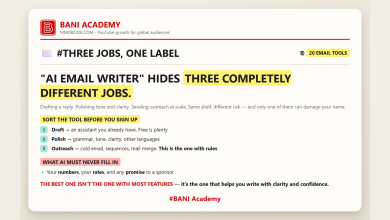
Gate two: the claims in the script. The scriptwriter agent produces something confident. Confidence is not accuracy, and the agent that wrote it cannot be the one that approves it — that separation is the whole argument of The Thing That Makes It Can Never Be The Thing That Grades It. Anything that is a number, a date, a name or a promise gets checked by something that did not write it.
Gate three: the publish button. The cheapest and most valuable one. Let the pipeline produce a finished cut and a filled-in upload form, and keep the last click. It costs you ninety seconds per video and it is the difference between a channel you run and a channel that runs.
Four honest caveats
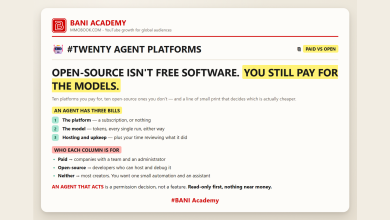
One free repository is not a free system. The card is accurate — the agents are prompt files in a repo and the repo costs nothing. The running costs are elsewhere: model calls for every script and every analysis, text to speech for every video, generated images for every beat. That gap between free software and a free system is the subject of Open-Source Agents Still Pay For Models.
A synthetic voice is a disclosure, not a secret. Layer four sends the script to text to speech. That is a legitimate way to make videos and plenty of good channels do it. Say so — in the description, or on screen. Platforms increasingly require it for realistic synthetic media, and an audience that finds out on its own reacts far worse than one that was told.
Automated uploading has rules attached. Scheduling your own videos is ordinary. Mass-producing near-identical content, or running a pipeline with nobody reviewing it, moves towards what platforms call inauthentic or mass-produced content, and the consequences land on the channel rather than on the repo. Keep gate three and this stays a tooling question.
Give each agent the narrowest access that works. Seven agents means seven things holding credentials — to your analytics, your channel, your storage. Start read-only, widen only when something genuinely fails, and never let the publishing agent hold more than it needs: Read-Only First.
Build it in the opposite order
If you want this, do not build agent one first. Build agent seven.
The loop layer is the only part that compounds, and it is also the cheapest to build, because it is just a monthly document: what went out, what the numbers were, what you changed, what you learned. Do that by hand for two months and you will know exactly which metric belongs in the loop, which is the question no repository can answer for you.
Then add the layer that hurts most. For most people that is packaging — thumbnails and titles — because it is the step everybody rushes at midnight. Then writing. Leave production and publishing until last, because those are the ones where an unsupervised mistake actually reaches an audience.
Seven agents built in that order is a system. Seven agents installed in one weekend is a very fast way to publish things you have not read.
Questions people ask
Does the calendar really rewrite itself? It can, and that is the clever part. Whether it should is the question — a calendar that updates from last month’s numbers is excellent; one that updates from last week’s trends is how a channel loses its subject.
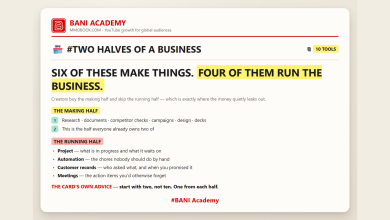
Is seven agents overkill for one person? As software, yes. As a list of the seven jobs that exist between an idea and a published video, no — you are already doing all seven, badly, at eleven at night. The diagram is more useful as a checklist than as an installation.
Can I use this and still appear on camera? Everything except layer four applies unchanged. Planning, writing, packaging, publishing and the loop do not care whether the face is yours.
What if the analytics say something I do not like? That is the loop working. The failure mode is not a bad number, it is quietly dropping the metric that produced it and picking a friendlier one — which is the same as having no loop at all.
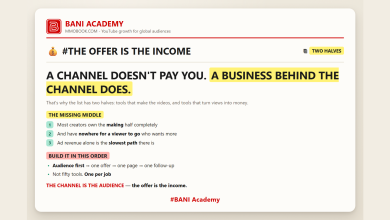
Where does the audience fit in all this? Nowhere on the diagram, which is worth noticing. The pipeline makes videos; it does not make a reason for anyone to come back. That distinction is the one we keep returning to in The Channel Is The Audience, The Offer Is The Income.
Seven agents, five layers, one decision
The architecture on this card is sound and the caption is right about why most automation fails: without the last agent, nothing compounds. Close the loop and you have something that genuinely improves month after month.
Just remember what it improves. It will get better at the number you hand it, relentlessly and without taste, for as long as you leave it running. So choose that number as carefully as you would choose a business partner, keep the human at the three gates, and let the calendar rewrite itself — towards something you would still want to have made.
Learning a lot does not make anyone good. Doing a lot does.
If you want a deadline rather than a saved architecture diagram, we run a free challenge — there is no barrier to entry, only a commitment fee that is refunded when you finish. It exists because a deadline builds agent seven, and a bookmark builds nothing.
Which number would you put in the loop, and why that one? Tell us in the comments under the original reel.
More on building a channel for a global audience at mmoyoutube.com.
One Comment